
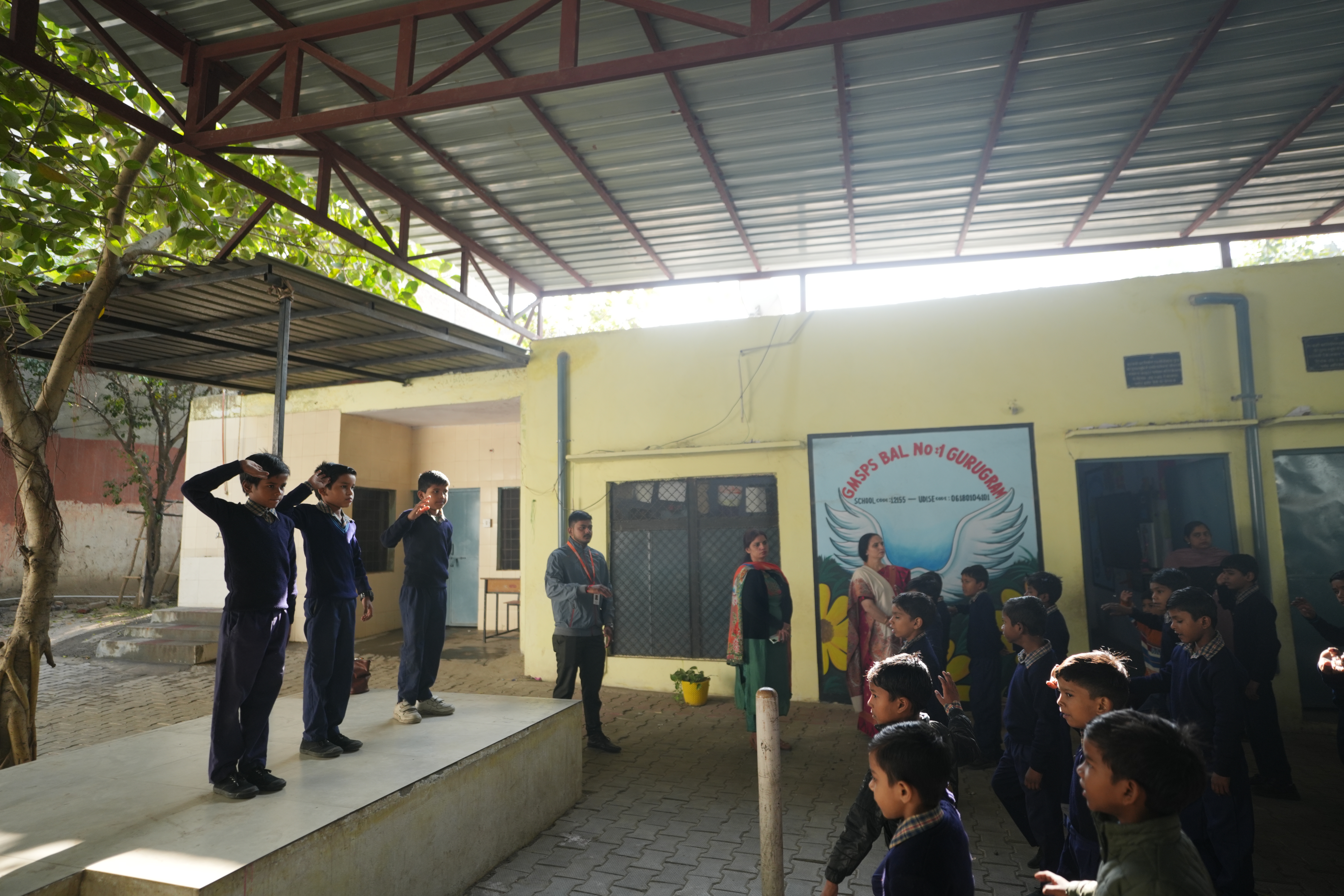
Why Holistic Education Requires Support for Both Teachers and Students?
Holistic education requires a collaborative approach to strengthen the entire learning ecosystem. It focuses on supporting both students and teachers.
Across many government and rural schools, educators still face challenges such as limited learning resources, multigrade classrooms, and varying learning levels among the children. At the same time, children often lack access to engaging learning experiences that develop confidence, curiosity and foundational skills.
Addressing these challenges requires a balanced approach. NGOs working in education in India address these challenges by providing more than learning resources to children. It equips the teachers with the right tools and support while creating an inclusive learning environment for the children.
That’s where organisations like Sampark Foundation help transform classrooms through practical and scalable solutions.
Why Teacher–Student Collaboration Matters in Learning
Learning is most effective when children feel free to ask questions and engage in learning sessions with their educators. When children participate in classroom discussions, they become more confident learners. Teachers focus on creating a classroom environment where every child feels included through inclusive, innovative teaching methods.
Collaborative classroom environments encourage children and strengthen their communication, critical thinking, and problem-solving skills. Creating a more inclusive learning environment for them and making learning a more engaging and enjoyable process for them. They also assist teachers with various learning tools to better understand student needs and adapt their teaching accordingly.
How Non-Profit Organisations in India Support Educational Reform
A non-profit organisation in India often plays a vital role in bridging the gaps within education systems, particularly in underserved communities.
Education-focused NGOs work alongside governments, school leaders, and teachers to strengthen learning outcomes, rather than replacing schools.
By contributing towards teacher training programs, access to innovative learning resources, classroom support, and curriculum-aligned interventions, NGOs working in the education sector in India help create inclusive learning environments for children across.
All these efforts help improve the overall educational quality and create models that can be sustained and scaled across larger school systems.
Better Learning Outcomes Through Classroom Teaching Kits
One of the most effective ways to enhance educational outcomes is the use of classroom teaching kits. Children learn effectively through experiments, practical demonstrations and exploration. Educational kits help teachers simplify abstract learning concepts through playful, interactive activities.
Classroom teaching kits also support teachers in delivering lessons and help maintain consistency in learning across classrooms.
Educational Help for Teachers Creates Stronger Classrooms
Quality education depends heavily on confident educators. Non-profit organization in India offer educational help for teachers through teacher training, mentoring, and instant academic support. At Sampark Foundation, the Sampark Didi Helpline is a dedicated helpline for educators that assists them with continuous improvements and technical and academic support.
With dedicated support systems, teachers can deliver lessons more effectively and respond to different student needs with instant support. These tools also help them reduce preparation time and improve classroom outcomes.
When teachers are empowered, students benefit directly.
Encouraging Curiosity Through Sampark Didi Ke Sawaal
When children are curious about a topic, they learn it eagerly. Sampark encourages this curiosity through initiatives such as Sampark Didi Ke Sawaal. A gamified quiz-based learning tool that allows children to think, respond, and engage actively with classroom concepts through interactive, question-based learning.
Quiz-based learning transforms passive learning into a participatory, engaging experience. With NGO-driven approaches, teachers can strengthen comprehension, improve concept recall, and help them collaborate confidently with their peers.
These tools also create opportunities for teachers to assess understanding in a more engaging and learner-friendly manner.
Building Sustainable Education Systems for the Future
Building an inclusive learning environment for children across rural and underserved communities requires collaboration and sustainable learning models.
When teacher empowerment, student engagement, community participation, and access to quality learning resources are all present, classrooms become active learning environments. When these elements work together, schools are better positioned to deliver consistent and meaningful learning experiences.
As education continues to evolve, scalable and inclusive models remain critical to ensuring that quality learning reaches every child, regardless of geography or background.
Conclusion
NGO working for education in India play an important role in strengthening learning outcomes across rural and government schools. It supports both teachers and students as partners in the educational journey.
Through teacher capacity-building, interactive learning tools, and classroom innovation, organisations such as Sampark Foundation are helping to create stronger, more inclusive learning environments that prepare children for the future.
FAQs
1. Why is teacher support essential in primary education?
Teacher support helps teachers address diverse learning needs and solve academic queries with instant support, and improves the overall classroom learning outcomes.
2. How do classroom teaching kits improve learning?
Classroom teaching kits promote hands-on and activity-based learning. When the teaching kits become a part of classroom learning, it improves understanding, engagement, and retention among the students.
3. How do NGOs improve learning quality in India?
Indian Education NGOs collaborate with institutions, governments and schools to support education through teacher training, learning resources, classroom innovation, and community engagement initiatives.
4. Why is educational innovation important for students?
Innovative learning tools and teaching approaches make learning more engaging. It encourages children to participate actively and helps them develop critical thinking and problem-solving skills.


