
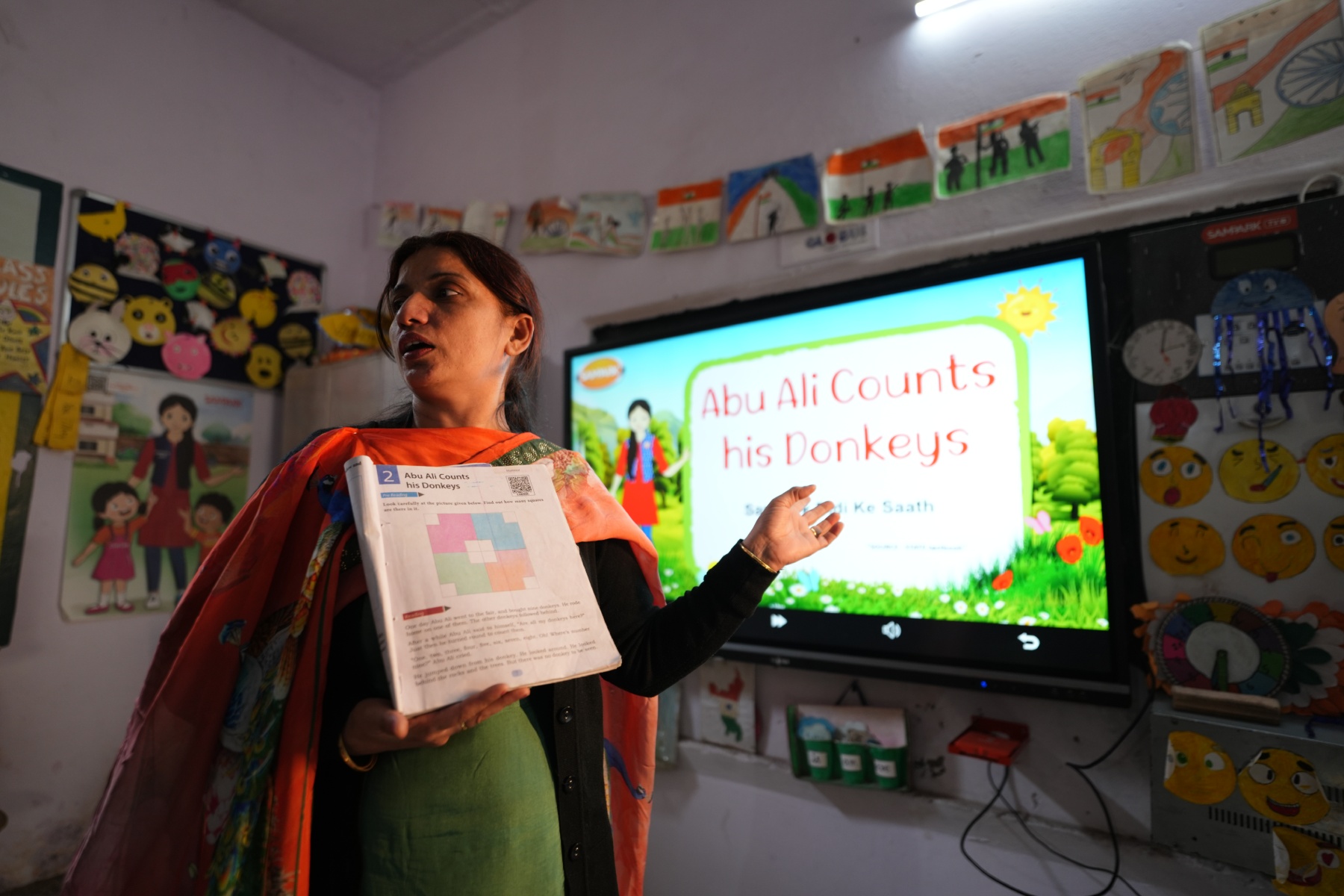
Introduction: Why Foundation Literacy and Numeracy Shapes STEM Readiness?
Foundation literacy and numeracy go beyond helping the children read sentences and solve basic sums. It determines how confidently a child explores the world of science, technology, engineering, and mathematics. When children learn to read with a better understanding, they begin to work comfortably around numbers, engage and ask questions, identify patterns, and follow logical processes.
All these abilities form the cognitive foundation necessary for STEM learning, helping children become curious and understand concepts effectively.
Strengthening FLN in education has become essential for preparing students to participate in a knowledge-driven future and achieve academic success. Early foundational learning builds curiosity, reduces fear of complex subjects, and prepares learners to experiment, analyze, and innovate.
Importance of Numeracy Skills in Science, Technology, Engineering, and Mathematics Learning
STEM education is heavily reliant on numerical understanding. Whether students are measuring distances in science experiments, recognizing coding patterns, or analyzing data trends, numeracy serves as the universal language that connects all STEM disciplines. And the early numeracy helps in achieving the SDG 4 quality education goal by helping children:
- Understand measurements, quantities, and comparisons
- Recognize patterns and sequences
- Interpret graphs, visuals, and data
- Develop logical reasoning and structured thinking
Students who gain comfort with numbers at the foundational stage are less likely to experience anxiety about mathematics and science in higher grades.
STEM Education Program Integration in Primary Education
Introducing a STEM education program during primary schooling enables children to connect learning with real-life experiences. Rather than separating subjects into silos, activity-based STEM learning encourages students to explore concepts through experimentation, model building, observation of outcomes, and solving practical challenges.
In early grades, STEM readiness can look simple:
- Counting through different measurement activities
- Understanding motion through play-based science experiments
- Exploring shapes and structures through construction tasks
- Observing nature to build scientific curiosity and learn about different elements of nature
When schools introduce STEM concepts alongside foundational literacy and numeracy, they help children develop confidence to engage with complex ideas and grow in their academic journey.
Concept-Based Learning Improving Analytical Thinking
Memorization may help students pass examinations, but conceptual understanding enables lifelong learning. Concept-based teaching focuses on helping children understand the reasoning behind ideas and encourages them to participate with curiosity. When students grasp concepts instead of recalling facts, they begin to:
- Analyze and look for solutions to problems independently
- Form logical connections between subjects
- Test hypotheses through observation and examination
- Apply knowledge across multiple contexts of other subjects
For example, reading comprehension strengthens the ability to interpret scientific instructions, while numeracy supports experimentation and data interpretation.
Early Exposure to Problem-Solving Activities
Problem-solving begins long before the formal STEM subjects are introduced in the classroom. Simple classroom practices and activities such as puzzles, group challenges, storytelling-based mathematics, and observation exercises nurture decision-making and resilience in young learners from the beginning of their learning journey.
Early exposure to such activities helps children:
- Explore multiple solutions to a problem
- Collaborate and communicate with peers
- Develop persistence when answers are not immediate
- View mistakes as part of learning
All of these skills form the behavioral foundation of STEM learning, where experimentation and iteration are essential. Children who develop problem-solving abilities early are more willing to engage with innovation-driven fields later in life.
Role of Teachers and NGOs in Promoting STEM Education Culture
Teachers remain the strongest drivers of educational transformation, as they act as the most important guiding partners in a child’s educational journey. However, enabling STEM readiness requires consistent support, training, and access to appropriate tools.
In this context, an education NGO in India plays a crucial role by bridging systemic gaps, by:
- Guiding teachers with training aligned with the foundational learning goals
- Introducing structured pedagogies and learning tools that combine literacy, numeracy, and exploration with activity and play-based learning
- Supplying teaching-learning materials and digital tools that are frugal and accessible without any reliance on internet connectivity
- Monitoring progress through data-backed systems
Organizations like Sampark Foundation work closely with governments and educators to ensure STEM learning opportunities are incorporated into the daily classroom learning. Ensuring that quality learning reaches underserved classrooms, enabling equity in educational outcomes across regions.
Preparing Students for Future Careers Through Strong Basics
Early foundational learning skills prepare students for future opportunities. It develops a clear understanding of concepts, and children begin to learn, analyze, and solve problems on their own. The inclusion of STEM education programs in the classroom encourages students to actively engage and understand concepts with better critical thinking and innovation.
When children master foundational literacy and numeracy skills early, they begin to:
- Understand emerging technologies
- Participate in innovation-led industries with more curiosity
- Think creatively and critically
- Continue learning throughout life
Strong foundational education enables students to adapt to the evolving markets and build strong foundations for lifelong learning.
FAQ
1. Ideal age to introduce STEM readiness concepts
STEM readiness can begin in early primary grades by introducing play-based activities like block-building, observation activities like exploring nature, and numeracy-focused learning experiences like sorting shapes and counting objects.
2. Benefits of numeracy in long-term academic growth
Numeracy builds logical reasoning, analytical thinking, and data interpretation skills essential for science, technology, and real-world problem-solving.
3. Examples of classroom STEM activities for young learners
Activities such as hands-on creative experiments, measurement games, construction tasks, nature observation, and collaborative problem-solving activities effectively introduce STEM concepts.
4. Long-term impact of foundational learning on career readiness
Strong literacy and numeracy skills allow students to adapt to technological change, pursue higher education with confidence, and succeed in innovation-driven careers.


