
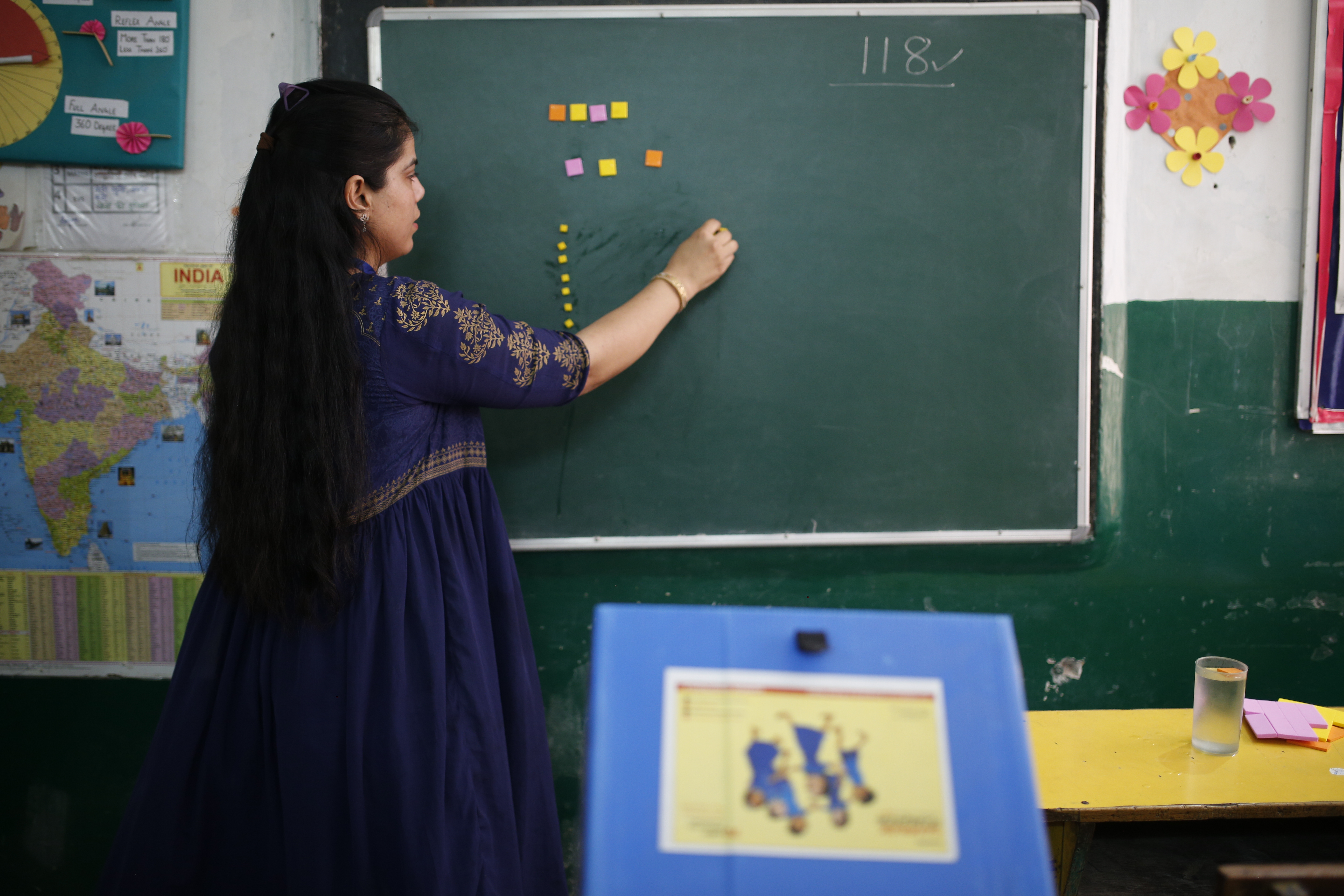
Indian classrooms have focused only on foundational literacy and numeracy skills, but they miss out on strengthening the lifelong skills that enable students to learn, explore, and progress towards real-life experiences.
The challenge is the gap in learning progression; schools and educators need to maintain hierarchy in the learning environment. By introducing a well-designed STEM education program that represents the next step after foundational learning. In which students move beyond basic literacy and numeracy toward analytical thinking, problem-solving, and real-world application.
This blog explores the learning progression of Indian classrooms and how strong FLN & well-designed STEM education programs support children in their lifelong learning and growth.
STEM Education Program Built on Strong FLN in Education
The beginning of a STEM education program relies on a strong FLN in education. When children learn to read instructions and understand vocabulary and logical concepts clearly, they begin to build strong foundational skills that lay the foundation for early education.
When the students achieve FLN proficiency, they begin to understand scientific and mathematical concepts more clearly. It develops the cognitive ability of the children, allowing them to think, interpret and solve problems easily and on their own.
FLN in education and STEM educational programs are interconnected and play a crucial role in developing children’s lives. Without these basics, STEM risks becoming another memorisation-heavy subject. With FLN, it becomes exploration.
NIPUN Bharat Mission and the Future Learning Pipeline
NIPUN Bharat Mission, India’s national initiative that ensures every child in India attains foundational literacy and numeracy in the early years of learning till class 3. It aims to create a strong foundation for the children and their advanced learning stages.
NIPUN Bharat Mission goes beyond supporting the foundational journey of the children; it helps their transition from literacy and numeracy to analytical thinking and competency-based learning. It allows educators to prioritise early benchmarks and introduce experimentation, reasoning, and problem-solving, the core of STEM education.
STEM Programs in Schools Strengthening Conceptual Understanding
Effective STEM programs in schools encourage young learners to participate, think and learn through observation, trial and their own curiosity. When children grasp scientific concepts, teachers can measure the classroom objects, outcomes, and mathematical thinking long before formal STEM labels appear.
Applied numeracy helps students measure, compare, and analyse patterns. Science activities nurture curiosity about how the world works. Engineering thinking introduces experimentation and iteration from an early age.
STEM education curriculum, therefore, becomes an initial part of a child’s educational journey, developing a mindset of curiosity in the early school years.
Classroom Innovation Through Fun Quiz for Students
One of the most underestimated drivers of STEM education is practice through engagement. Engagement plays a critical role in sustaining learning progression. A fun quiz for students transforms assessment into participation, allowing the children to learn and reinforce concepts with gamified quizzes, collaborate and discuss subjects with peers, and understand with instant feedback.
Interactive quiz-based learning reduces fear of mistakes and promotes continuous practice. Instead of viewing evaluation as pressure, children experience learning as discovery and achievement.
Data-Driven Teaching Strategies Supporting STEM Learning
Data-driven teaching strategies help educators make informed decisions, identify learning gaps early, and adapt accordingly. With structured dashboards and classroom insights, they get more clarity on classroom learning.
With those insights, educators can understand and identify the problems students are struggling with in foundational skills, adjust lesson pacing to the children’s understanding, and provide targeted remediation before learning gaps widen.
This continuous feedback loop ensures that STEM learning is built on readiness, not expectation.
Role of NGOs Like Sampark Foundation in Bridging Learning Stages
NGOs support, as a systematic partner, in bridging the learning-journey gap through rural scalability, teacher support, and frugal, innovative learning tools. Organizations like Sampark Foundation help schools align with the educational standards and cater to the needs of diverse learners.
Sampark Foundation brings an integrated model that combines structured FLN pedagogy, teacher training and capacity building, smart classroom innovations such as smart TVs for teaching and teach-easy kits, and scalable monitoring systems.
By focusing on scalability, affordability, and teacher empowerment, such models ensure that children in rural and underserved communities receive the same opportunity to develop future-ready skills as their urban peers.
FAQs
1. What makes the Sampark Smart Why is FLN important before STEM?Shala App different from other educational apps for children?
Foundational literacy and numeracy are the first and foundational stage for students. Where they learn to read instructions, understand data, and apply logical reasoning required for further STEM learning.
2. What role does NIPUN Bharat play?
NIPUN Bharat mission ensures all children achieve foundational learning by Grade 3, creating readiness for higher-order skills and STEM education.
3. How do quizzes support STEM learning?
Quiz-based learning reinforces concepts with fun and engagement, it also provides instant feedback, and improves engagement through interactive participation.
4. Are STEM programs suitable for primary grades?
Yes. Age-appropriate and activity-based STEM exposure builds curiosity, problem-solving skills, and confidence from early years.


