
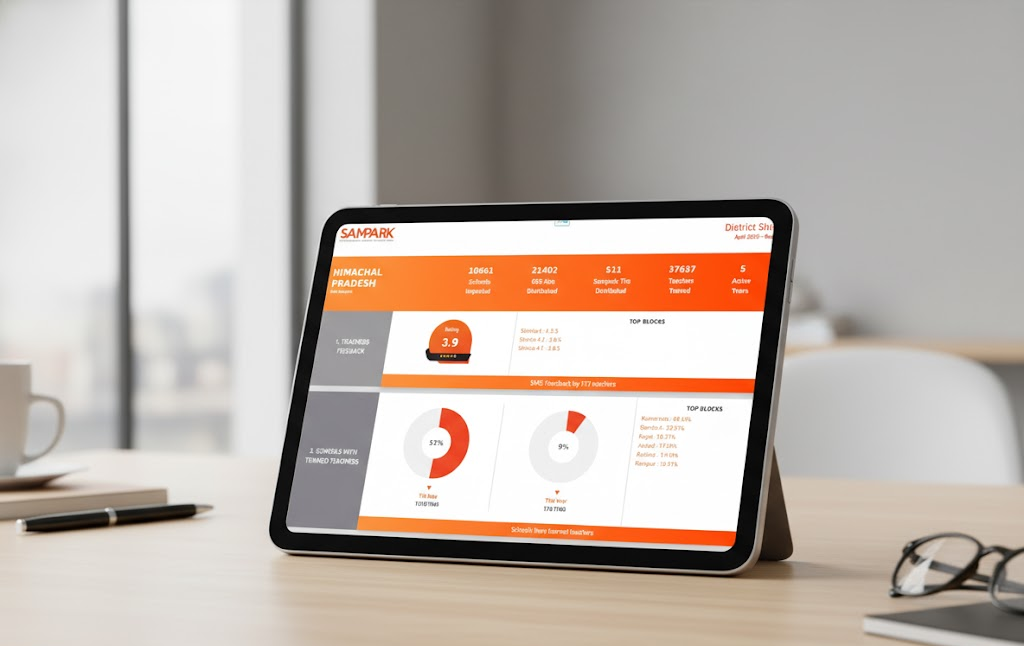
Introduction to Digital Dashboard for Education and Classroom Insights
Without real-time visibility into daily classroom activities, managing large-scale public school systems presents significant logistical challenges, especially when overseeing thousands of students across diverse regions. Administrative teams struggle to evaluate whether instructional tools are being used effectively or if teaching stays aligned with the prescribed curriculum.
Today, supervision is dependent completely on manual paper surveys filled out by teachers and periodic physical visits by administrative teams. This dependence on traditional methods often delays information, making it quite tough for educators to identify learning gaps as they happen on the ground.
A digital dashboard for education solves this visibility bottleneck by consolidating fragmented classroom data into a single, structured overview.
Moreover, digital assessment platforms like the Sampark Dashboard help to centralise real-time data from classroom interventions, translating it into clear analytics that support data-driven decision-making across state, district, block, and school levels.
Digital Dashboard for Education Improving School Oversight
Manual record-keeping across hundreds of rural classrooms increases human error, and it also consumes valuable instructional time. By centralising key operational data through a digital dashboard for education, it helps to solve these issues by replacing manual paperwork with automated app tracking.
- Automated Data Capture: Replacing physical registers with digital syncing reduces manual errors and saves critical teaching time.
- Streamlined School Oversight: Real-time data logging eliminates administrative delays, giving leadership instant visibility into classroom operations.
- Data-Driven Interventions: Immediate alerts allow educators to address learning gaps and underutilised resources as they happen.
School Evaluation Dashboard Supporting Better Decision-Making
Evaluating educational institutions across different regions or districts requires standardised, objective criteria. A dedicated school evaluation dashboard helps to establish clear performance baselines, which allows education departments to evaluate schools individually against regional benchmarks and transform raw administrative data into actionable strategies across every level.
Modern monitoring frameworks like the ones mentioned below help to optimise school evaluation across key operational areas:
Attendance & Resource Tracking: By replacing paper registers with an automated app, syncing provides instant visibility into school-wide attendance and tool usage.
Assessment & Gap Analytics: Moving away from manual test tallying to digital mark submission enables real-time identification of learning gaps.
Curriculum Coverage Oversight: When transitioning from periodic visits to continuous digital lesson tracking, it helps to ensure immediate detection of pacing delays.
Targeted Resource Allocation: Upgrading static inventory audits to live resource usage analytics helps to deliver classroom teaching kits and support materials precisely when and where needed.
Instead of relying on broad assumptions, administrators can identify specific classrooms that need extra support or training. Clear, tier-wide reporting provides reliable data, allowing leaders and funding partners to track progress and direct mentorship where it makes the biggest impact.
Teaching Progress Tracking System Strengthening Classroom Delivery
Even well-developed educational resources are not sufficient if the lessons are not properly delivered. Teaching progress tracking systems allow teachers to track completed classes and follow a consistent pace of delivery. Using the mobile version of the tool, teachers can log their progress as they go through the lesson plans, ensuring that no concepts are skipped over too quickly.
Academic coordinators and mentors can use curriculum monitoring to guide and coach other teachers. Instead of giving generic training seminars, they can use the information from the dashboard to identify the topics that need to be discussed in detail. As such, mentors can provide relevant support and assistance to other teachers.
Data-Driven Teaching Strategies Improving Student Outcomes
Shifting from intuitive to data-driven teaching strategies completely changes the teacher’s approach to the varying speeds of student learning. By continuously analysing the results of class assessments, instruction can be adapted to best address the class’s specific misconceptions and problem areas before they become widespread issues.
- Early Identification of Skill Gaps: Automatically graded quizzes show the teacher which subjects or skills the class is struggling with below a certain benchmark.
- Contextual Remediation: The teacher uses visual aids such as classroom teaching kits or animated lessons on Sampark TV to help students learn the concepts they are struggling with.
- Instructional Grouping: Students are grouped by skill level, allowing the teacher to instruct smaller groups more effectively.
- Longitudinal Tracking of Progress: Regular assessments determine whether the intervention is helping students close the gap in their learning.
School Performance Tracking Dashboard Enabling Transparency
A good school performance tracking dashboard enhances accountability by providing insight into the state of education. The state, NGOs, and the district magistrate can see at a glance the big picture as well as the details of individual schools, without waiting for information to come in manually.
This improves compliance and reporting, since automated dashboards can carry out the task faster and more efficiently than people, and generate standardised reports for CSR partners or state authorities. This, in turn, can build confidence and trust among stakeholders, as it demonstrates that their investment of time and resources is leading to quantifiable outcomes.
Conclusion: Digital Dashboard for Education Driving Smarter Schools
The digital dashboard for education helps enable a shift from guesswork to quantitative, evidence-based decision-making. By combining classroom analytics with practical resources such as classroom teaching kits and video content on Sampark TV, it makes teaching more effective while ensuring learning materials are fully utilised.
This method helps to place data-driven innovation at the centre of democratising public education across India. Centralised performance tracking provides the visibility needed to strengthen teaching strategies and deliver measurable improvements in classroom learning outcomes nationwide.
FAQs
1. What is a digital dashboard for education used for?
A digital dashboard for education helps in centralising school operational data, teacher activity logs, resource usage metrics, and student performance scores into a single platform. It also allows administrators, teachers, and partners to track classroom activity in real time and make informed decisions to improve learning outcomes.
2. How does a school evaluation dashboard help administrators?
A school evaluation dashboard benchmarks school performance against regional standards, helping administrators identify low-performing classrooms or underutilised educational tools. This accumulated data allows authorities to allocate funding, mentorship, and physical resources to the specific schools that need them most.
3. What is a teaching progress tracking system?
A teaching progress tracking system helps in monitoring daily lesson coverage and curriculum pacing. It also helps teachers stay on track with academic calendars while providing coordinators with visibility into instruction consistency and training needs across multiple schools.
4. How do data-driven teaching strategies improve outcomes?
Data-driven teaching strategies help to utilise direct assessment data to highlight specific learning gaps. Instead of being dependent on general assumptions, teachers use these insights to adjust lesson delivery, deploy targeted teaching aids, and personalise instruction to match any student’s learning speed.


