
The Educational App Redefining Classroom Learning in Rural India
An educational app today has the power to transform how children learn and grow. But these apps deliver real outcomes only when they are designed for real classroom realities, not ideal conditions.
Most mainstream EdTech platforms are built for urban, English-speaking students who operate with stable internet access and personal devices. However, millions of children studying in government schools and rural areas across India face a very different reality: limited connectivity, shared devices, multilingual classrooms, and a single teacher managing large or multi-grade groups in classrooms with few resources.
This digital divide defines that technology alone cannot solve learning gaps in the country. What India needs are context-aware interactive teaching apps for children that are frugal, innovative, and adaptable to rural ecosystems.
As an Indian education NGO, Sampark Foundation focuses on developing practical, inclusive, and scalable solutions. Sampark ensures that technology strengthens teaching instead of complicating it.
The Shift From Passive Learning to Active Engagement
Traditional textbook-driven classrooms often encourage rote memorisation rather than contextual understanding of the subject. Children just listen, copy, and repeat without participating in or interacting with the classroom learning process. In this context, a well-designed digital learning solution for children changes this dynamic learning landscape by introducing:
- Visual learning tools in the classroom learning that simplify complex concepts with interactive visuals and easy explanations
- Audio-based guidance that supports early readers
- Activity-led exercises that encourage participation and collaboration between children
- Immediate feedback that reinforces learning and tracks progress
With interactive learning, classroom environments become spaces for exploration where children can participate with curiosity, improve their attention spans, and build confidence. Children retain information better when they see, hear, and do rather than just read or listen.
Core Features That Make an Educational App Effective for Young Learners
The educational app for children delivers meaningful learning outcomes only when it is designed for children with ease of use, voice-led instructions and offline functionality. And the most effective platforms share certain essential characteristics:
1. Child-Centric Design:
- With Large fonts and simple navigation
- Voice-led easy instructions for non-readers
- Minimal dependence on advanced reading skills
2. Curriculum Alignment:
Apps must match the state board curricula. So the teachers can easily integrate the tools directly into daily lessons rather than treating them as extra activities.
3. Multilingual Learning:
India’s classrooms are linguistically diverse. An app that supports regional languages to ensure comprehension and inclusion aligns with the learning goals.
4. Offline Functionality:
For rural India, offline capability in education is a necessity in remote communities where infrastructure and internet availability are uneven, because learning must continue regardless of these conditions.
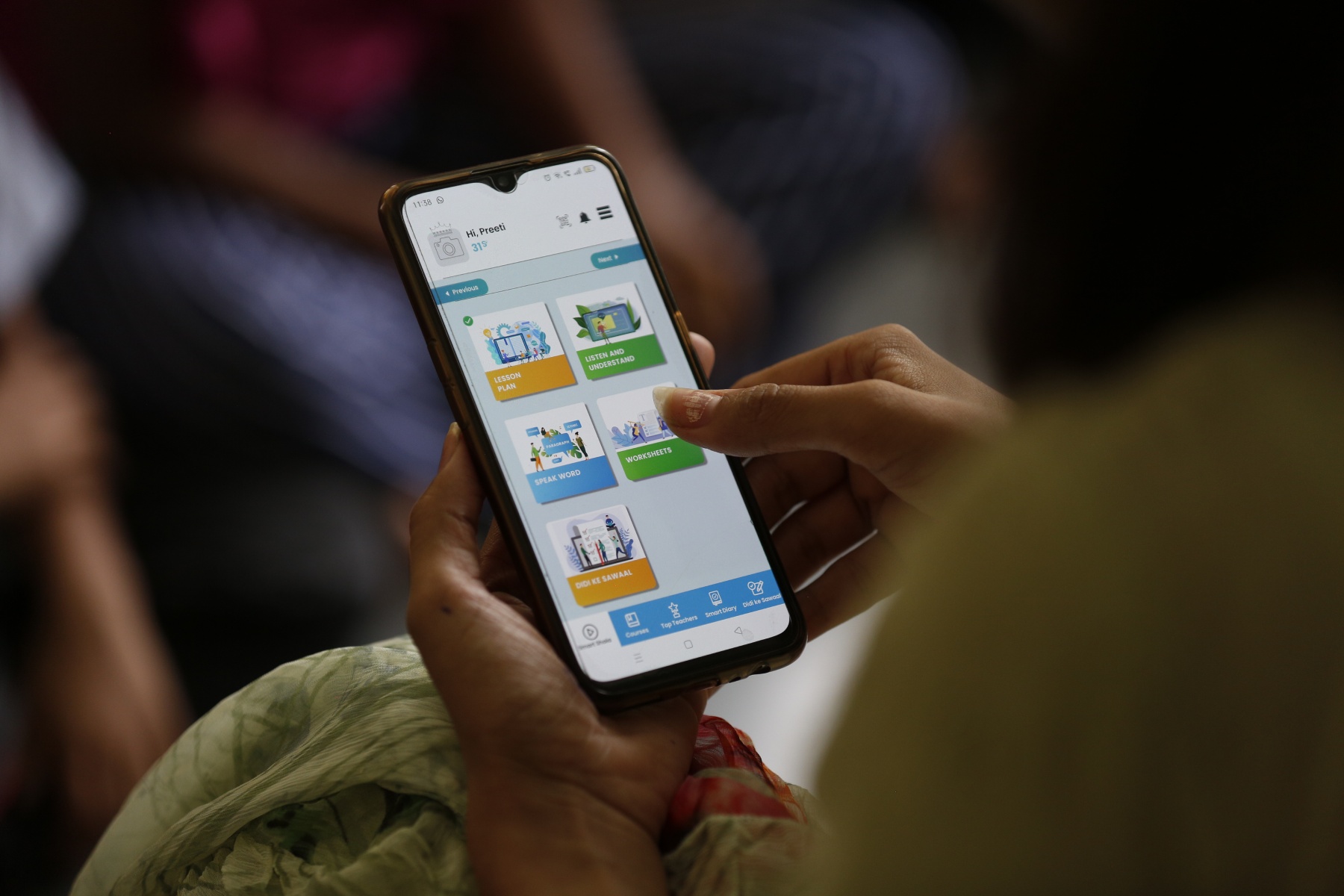
Sampark Foundation’s Smart Shala App is designed on these principles, combining structured lesson plans with multimedia content and assessments that work even in low-resource environments. Making Smart Shala App the first choice for teachers.
The Role of Indian Education NGOs in Driving App-Based Learning
Technology adoption in government schools requires ongoing support and training to make it a daily part of children’s learning. This is where an education NGO plays a crucial role.
NGOs act as implementation partners by:
- Training and guiding teachers to use digital tools confidently
- Providing interactive devices and classroom integration support to incorporate digital tools into the classroom
- Ensuring the curriculum relevance of all the digital tools
- Monitoring usage and learning outcomes from time to time
At Sampark Foundation, the educational app is integrated into the everyday teaching ecosystem, supporting teachers with training, interactive classroom tools, and continuous mentoring. With this integrated approach, Sampark ensures sustainability and continuous classroom growth.
Real Classroom Impact: What Changes When Children Use Learning Apps Daily
When digital tools become a part of classroom learning, a noticeable transformation occurs. And Teachers across Sampark-supported schools share their stories of impact:
- Anita Devi Ma’am
Head Teacher, GPS Bal No. 1 School, Gurugram, Haryana:
Sampark programmes have transformed classroom learning environments from low engagement and dropout concerns into joyful learning spaces where children actively participate every day. Hands-on activities like Sampark Didi ke Sawaal and structured learning tools have strengthened student confidence, curiosity, and sustained interest in studies. Turning students into more confident learners.
-
Deepshika Ma’am
Assistant Teacher, Composite School, Chhalera, Uttar Pradesh
Sampark’s engaging programmes have significantly improved student attendance by making classrooms more joyful and activity-driven. Animated lessons and interactive storytelling have encouraged children to attend school regularly and participate more actively in learning.
Challenges in Deploying Educational Apps in Low-Resource Schools
Despite the potential of these digital learning tools and solutions, implementing these tools remains a challenge for schools in rural and remote communities with limited resources. And some of the genuine challenges are:
- Limited charging infrastructure and device maintenance
- Concerns about excessive screen time amongst children
- Initial teacher hesitation toward implementation and technology adoption in the classroom
- Need for culturally and linguistically relevant content for the rural and government schools
All of these challenges can be addressed with continuous teacher training and support, offline-first design, and community engagement, providing children with an interactive learning environment in which quality learning becomes part of the regular curriculum.
Every Child in India Deserves Access to a Quality Educational App
An educational app for children is no longer a luxury tool reserved for elite schools or urban classrooms; it is now a necessity for equitable, high-quality learning across all segments of society, regardless of a child’s social background.
When the educational tools are designed for inclusivity, aligned with curriculum needs, and supported by teachers, these digital platforms can bridge longstanding learning gaps. Allowing children to have access to quality learning and experience engaging, meaningful education.
Through initiatives like the Smart Shala App, Sampark Foundation, a non-profit organisation in India, continues to expand access to scalable digital learning solutions for children, empowering every child across India with the innovative learning tools they need to grow and thrive in the future.
Because quality education should not depend on location, it should reach every child.
FAQs
- What is an educational app, and how is it different from a standard learning website?
An educational app is a structured learning platform. It is designed for structured learning with interactive lessons, assessments, and offline accessibility, whereas websites typically require continuous internet access and self-navigation. - Are educational apps effective for children in rural areas with limited connectivity?
Yes. Offline-enabled educational apps specifically designed for low-resource classrooms can significantly improve engagement and learning outcomes among children in rural areas. - Which educational apps are used in Indian government schools?
Several NGOs and state partnerships deploy curriculum-aligned platforms such as Sampark Foundation’s Smart Shala App to support teaching and foundational learning with frugal, innovative learning tools across classrooms. - Can an educational app replace a teacher in the classroom?
No. Educational apps are supporting tools that assist teachers by improving lesson delivery, saving their preparation time, and enhancing student engagement.


