
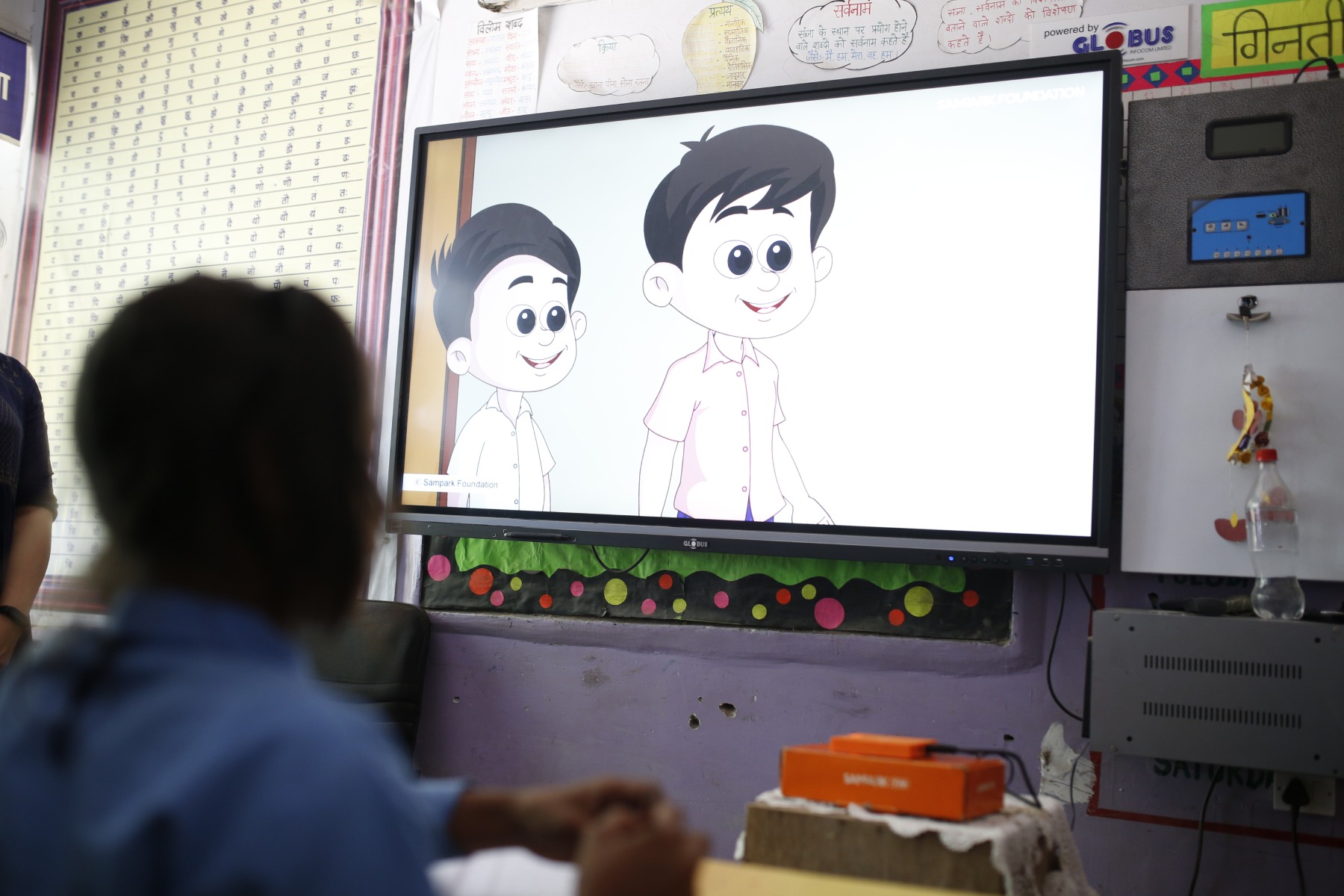
The Evolution of the Indian Classroom
Indian classrooms have transformed over time, from traditional teaching to modern digital and interactive learning methods. Many government schools still rely on accessible, easy-to-use and frugal innovations for classroom learning.
Emerging innovative tools such as smart TVs for teaching, interactive audio-visual learning kits, and other accessible tools are making the digital classroom a reality in many remote and underserved communities.
The shift from blackboards to digital boards with smart TVs makes audio-visual learning scalable. It allows teachers to create and offer engaging, immersive learning experiences for students.
Why Choose a Smart TV for Teaching? Key Benefits
Integrating Smart interactive TV for schools completely transforms the way students learn, engage, and participate in the classroom.
Visual Impact: The inclusion of high-definition videos, animated explanatory videos, and 3D simulations makes abstract ideas tangible. Whether it is understanding the solar system or visualising fractions, audiovisual learning for kids strengthens comprehension by helping them see what they are learning.
Interactive Learning: With interactive quizzes, playful classroom games, storytelling sessions, and group discussions, smart TVs play a key role in strengthening the interactive learning process for children. Smart TVs enable teachers to pause, ask questions, and actively involve students, turning passive viewing into dynamic participation.
Cost-Effectiveness: Compared to projectors, smart TVs are durable, low-maintenance, and energy-efficient. They operate smoothly in resource-limited areas without reliance on heavy infrastructure or high maintenance. When evaluating smart TV vs interactive flat panel for teaching, many schools find TVs to be a more sustainable solution for long-term use.
Beyond the Hardware: The Need for “Smart Content”
Smart class content for primary schools becomes powerful only when they deliver value to the children. To improve learning outcomes, schools need to ensure that digital teaching aids for classrooms are curriculum-aligned, accessible, and available in regional languages to support effective learning in remote and rural classrooms.
Smart TVs aligned with high-quality, curriculum-aligned digital content available in local languages, with structured lesson plans, ensure that technology serves as a supportive aid for teachers.
The Sampark TV Edge: Offline Intelligence
This is where Sampark Foundation fulfils this gap through its Sampark Smart Shala TV integration model. Designed specifically for government schools, Sampark TV converts a standard television into an intelligent classroom solution, without relying on constant internet connectivity.
Sampark TV’s offline capability makes it a cost-effective and reliable source in regions with inconsistent connectivity. It delivers preloaded, high-quality curriculum-aligned content for primary schools without requiring internet access during lessons.
By eliminating the dependence on heavy infrastructure and continuous internet connectivity, Sampark Foundation’s commitment, as an Indian education NGO, to making practical, scalable innovation a reality for rural classrooms becomes a success.
Features of an Effective Smart TV Setup for Schools
- Screen Mirroring: Teachers can cast lessons directly from their smartphones using the Sampark Smart Shala App. It makes the learning process more flexible and dynamic.
- Offline Access: Sampark’s Smart TV makes lessons, videos, and activities accessible without internet connectivity, ensuring continuity in low-resource settings. It allows teachers to conduct uninterrupted learning sessions.
- Curriculum Alignment: The Smart TV’s content is structured to align with the curriculum, supporting daily lesson plans and helping teachers integrate technology seamlessly into daily classroom learning rather than as an afterthought.
Transforming Teacher Pedagogy with Smart TV Tools
Thoughtful implementation of smart TV tools helps teachers deliver effective lessons. As the digital content assists teachers with:
- Visual content that reduces the explanation time
- Curriculum-aligned animated stories that spark interest and curiosity among children
- Structured lesson modules that provide clarity in content delivery.
All these features allow teachers to focus more on classroom-level factors rather than spend most of their time on lesson planning. Teachers can now focus on student interaction, addressing their doubts, and encouraging them to participate effectively in classroom learning. And in classrooms with high teacher-to-student ratios, such efficiency is invaluable.
By combining pedagogy with technology, smart classroom technology in India strengthens teaching confidence and student engagement.
Conclusion: The Future of Accessible Digital Education
The future of education in India lies in digital learning tools and the quality of the content they deliver. Sampark’s Sampark TV demonstrates how digital transformation can be inclusive and scalable with multi-media content and curriculum-aligned resources.
Sampark Foundation continues to democratise quality learning experiences across government schools with its smart classroom solutions that are affordable, offline-enabled, and teacher-friendly.
A smart TV for teaching transforms the traditional classroom into an engaging, active learning environment. It ensures that every child, regardless of geography, has access to engaging, meaningful, and modern learning experiences.


