
Building Smart Classrooms with Low-Cost Digital Tools in Rural India
In many rural schools in India, outdated teaching methods and a lack of resources make learning boring and hard to understand. Teachers find it difficult to engage students with limited tools, and students often memorise lessons without truly understanding them. This leaves them unprepared for real-life challenges and takes away the fun in learning.
Sampark Foundation is working to change this by providing simple, affordable tools that help teachers and students. By incorporating easy-to-use digital tools and hands-on resources, Sampark is transforming traditional classrooms into exciting, interactive spaces where students can truly enjoy learning and better grasp concepts.
Understanding the Challenges in Rural Classrooms
1.Limited Access to Technology & Internet – According to the UDISE+ 2024-25 report, only 63.5% of students have basic internet facilities. Many rural schools operate with minimal infrastructure, limited teaching resources and access to the internet and technology. Due to the unreliable availability of tools and resources, classrooms struggle to implement interactive digital learning.
2.Teacher Training & Digital Confidence – In many rural schools, teachers find it difficult to use technology due to limited exposure. Without hands-on training, innovative tools, teachers may feel hesitant to incorporate digital methods into daily lessons, which creates a challenge for teachers in making the classroom learning an interactive experience for children.
3.Limited Budgets in Government Schools – Most government schools work within strict financial constraints.[1] High-cost smart boards, advanced projectors, or subscription-based EdTech tools are often not feasible for them. These schools in rural areas need affordable smart classroom solutions that are reliable and scalable to support interactive learning.
4. Low Digital Exposure Among Children – For many students in rural areas, digital learning is a completely new experience. As first-generation learners, children gain the most from visual, story-led, and hands-on resources that spark curiosity, improve comprehension, and make learning enjoyable.
Why Smart Classrooms Are Needed
According to the UDISE+ 2024-25 Report, only 28.6% of government schools in India have access to digital boards and smart TVs for classroom learning, which highlights the widening gap between urban and rural schools.
Smart classrooms in rural India address this gap by offering visual, interactive, and easy-to-understand lessons that improve children’s engagement and learning outcomes. Digital classrooms in rural India enable students to learn through engaging, interactive video content and simplified storytelling.
Sampark Foundation aims to provide digital education by offering children and teachers scalable, easy-to-use, interactive and low-cost educational technology in India. With its six innovations, Sampark enables digital learning accessible in every rural school.
H2: Sampark’s Innovative Tools
Sampark Foundation uses simple yet powerful tools to improve education with edtech in rural India:
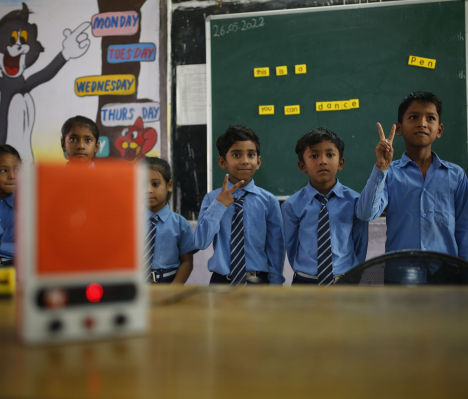
●Teach-Easy Kits – These kits combine board games, audio devices, and teaching aids to make subjects like math and English fun. They use physical manipulatives and audio resources to improve learning at a minimal cost.
●Smartshala App – This app provides ready-made lesson plans, videos, and quizzes aligned with government textbooks. Many teachers have used this app to make their teaching more effective and interactive.
●Sampark TV – By converting standard TVs into smart classrooms, Sampark TV offers interactive lessons without the internet. It brings digital learning to even the remotest schools.
●Sampark Didi Ke Sawaal – This quiz-based program makes classroom assessments enjoyable and stress-free. Students learn through gamified quizzes, which help boost their confidence.
● AI-Driven Speak English Program – This program uses animated lessons to help students improve their English speaking and comprehension skills, making them ready for modern job markets.
In 2023-24, a total of 48 schools have been transformed into smart classrooms under this initiative. This marks it as a significant step toward creating engaging, tech-enabled learning environments for students.
How Low-Cost Digital Tools Improve Teaching & Learning
1.Visual Learning Boosts Understanding – Affordable learning tools simplify complex concepts through images, animations, and storytelling. It helps sustain students’ attention in the classroom through playful interactive learning tools.
2. Increases Student Engagement – Interactive videos, sounds, and gamified activities encourage active participation among children. This shift from rote learning to experiential learning keeps children curious and motivated, and encourages them to participate actively in the classroom.
3.Saves Time for Teachers – Digital classrooms have pre-designed lesson plans and audio explanations, allowing teachers to focus more on delivery and students’ participation rather than on lesson preparation.
4.Overcomes Language Barriers – Audio-visual content available in regional languages ensures every child has access to education in their own language.
Impact On Students And Teachers
Sampark Foundation has trained over 8500,000 teachers to use innovative tools, making their classrooms more engaging and effective. With innovative programs implemented in over 84,000 [2] schools, millions of children have experienced the benefits of interactive learning, gaining confidence and developing a deeper interest in their studies.
Teachers have reported increased student engagement and improved academic performance, as passive classrooms transform into dynamic spaces filled with curious, eager learners. All this is achieved through cost-effective solutions, delivered at less than $1 per child per year, ensuring affordability and scalability across rural India.
Join us in our journey to building a smarter classroom for every child in rural India – Know more.
How Sampark’s Low-Cost EdTech Approach Is Transforming Rural Learning
Sampark Foundation uses a frugal innovation model to design high-impact, low-cost digital tools for education in India, making education accessible in every rural classroom. With its smart, simple, and innovative learning tools, Sampark ensures every teaching experience is fun, engaging and simple.
With audio-based lessons that work without internet and plug-and-play digital resources such as Sampark Smart TV, Sampark ensures seamless use even in low-tech schools.
Sampark’s model is easy to scale, enabling adoption across multiple states through strong partnerships with governments and local communities. It demonstrates that access to quality education with digital tools doesn’t have to be expensive.
Conclusion
Empowering rural students through digital learning is not just an innovation; it’s an opportunity to shape brighter futures and create lifelong opportunities for children.
As Sampark Foundation continues to make affordable, innovative, and digital classroom models accessible across India, we invite educators and policymakers to champion this transformation and help ensure that quality learning reaches every classroom, every time.


